
The Enabler Of Casual, Carefree Malfeasance
Scenario: You’re at your public library. You glance over at a chair that somebody vacated about twenty minutes ago, and you spot a wallet. What do you do with it?
What a question! You pick it up and you immediately hand it in to a librarian. Your ethical duty is so clear that the alternatives probably didn’t even occur to you. There happened to be $27 in cash inside, but you were unaware of this because you probably didn’t even bother looking. $10 or $1000, it’s all the same: you turn it in.
Let’s change this scenario up. It’s not a wallet. It’s $27 in cash, folded in half, with a paper clip holding it together.
Even if the wallet from the first scenario contained exactly the same amount of money…clinically, it’s a different thing:
- There’s no ID or credit cards. Tracking down the owner won’t be easy, or guaranteed.
- $27 isn’t a trivial amount of money, but it isn’t substantial, either. It’s possible that the owner will just write it off to carelessness and bad luck.
- Even if the owner thinks “Oh, I must have lost it in the library,” the owner might just assume that whoever found it pocketed the cash.
Objectively, you should still hand the money in. But even an upstanding citizen might have to walk themselves through their options before they do the right thing.
But if someone chose to conclude that this small windfall was just part of the Great Lost Cash Redistribution System that we all participate in, from one side or another, I wouldn’t judge them too harshly. This is “casual malfeasance.” Keeping the cash isn’t ideal, but the finder might have scrutinized the situation and concluded in the end that no real harm would be done.
(“Okay, Andy, but what would you do?” I’d hand the money in. But if I’d found it in the street…yeah, I wouldn’t go around knocking on doors and I wouldn’t drop it off at the police station. I’d take it almost directly to a good diner, fill up on an epic breakfast, and then tell myself that the 40% tip I left will wash away the any stain of sin.)
AI is an enabler of Casual Malfeasance
In fact, I did find a wallet at the library recently. And of course, I did hand it right in.
But I’m bringing up the concept because it’s occurred to me that “enabling acts of Casual Malfeasance” is one of the lesser issues of AI.
Y’see…I began sort of stealing comic strips today.
I don’t know if it’s wrong. I do know I wouldn’t be doing it if Gemini hadn’t made it so. Freaking. Easy.
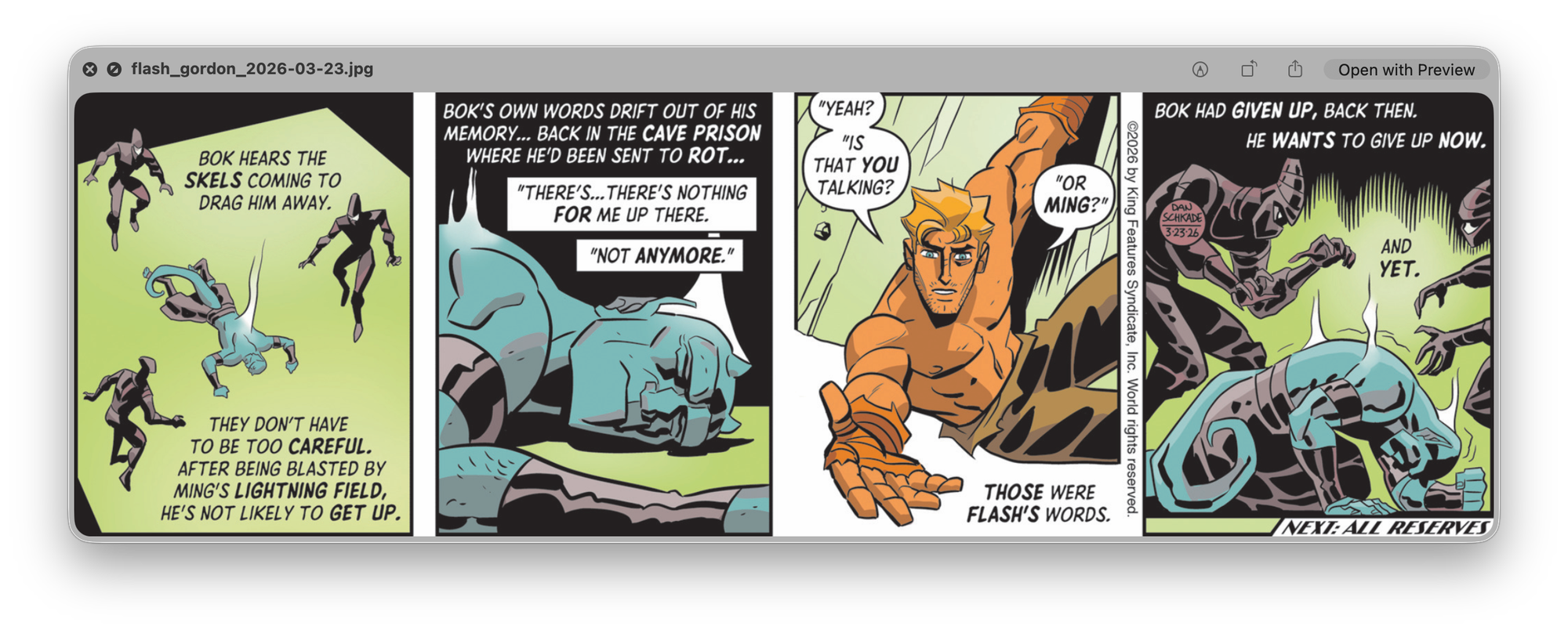
I start every day by reading the morning comic strips, via my paid subscriptions to Comics Kingdom and GoComics. One of my absolute favorites is Dan Schkade’s incredible revival of Flash Gordon. It’s a miraculous thing! He’s made this 90-year-old adventure comic into something modern and relevant, without rejecting everything that made the character iconic or keeping it at an ironic distance. Schkade took a beautiful old plant and repotted it in fresh soil.
If his Flash Gordon strips were periodically collected and sold in digest form, they’d be among the very best graphic novels being published today. Schkade says he’s suggested it to King Features Syndicate, but they haven’t done the sane and rational thing yet.
So. Why can’t I just right-click on this strip and save it to a folder every morning? At the end of each month, I can export the folder to a PDF or a CBZ file and make my own collected editions. I’m paying for these daily strips. I’d happily pay for an official monthly digest if King Features sold one, but they don’t. I won’t be sharing my homemade digests with anybody. So what would be the harm?
“What’s the harm” is a subjective ethical question.
“Why can’t I right-click and save” has a straightforward answer: the Comics Kingdom site has disabled it. I can download individual strips, but only if I open Chrome’s developer tools and inspect the traffic between the browser and the server until I find the direct image URL for today’s strip.
Thus, saving strips from the site is so difficult that I’m not even tempted to do it. I never needed to look at it from an ethical angle.
Then along came Gemini. This morning, while I was reading my daily comics as usual, I remembered that there are Python libraries for scraping stuff from websites. I prompted Gemini to write a Python script that grabbed the latest Flash Gordon strip, via Beautiful Soup.
To be honest, my mind wasn’t bent on malfeasance. I was just kind of curious to see if Gemini could come up with a solution. Mostly, I was looking for an excuse to stay in bed for another twenty minutes instead of getting dressed and starting my day.
But I’ll be danged! It worked perfectly, right off the bat:
(I’m just gonna go ahead and call this screenshot “Fair Use.”)
A pro-level Python coder could have banged this script out in minutes. But I’m only a hobbyist. Without generative coding tools, it would have taken me an hour or more before I had the script running, reliable, and rock-stable. So much work! I doubt I would ever have bothered.
But with that tool, I was able to create this script on a whim, using next to zero effort. I didn’t even have to think “Hey, I could set things up so that launchd or something runs this script every day, automatically.” Nope! Gemini, on its own, asked me if I’d like to learn how to do that exact thing.
It all went by so fast that I didn't stop to ask myself if there was any kind of an ethical problem with using this script. I've thought about it since, and no, I think I'm fine with this. I'm not entitled to monthly digests of this strip. But I'm paying for everything that King Features is letting me pay for and I'm just generating something for my personal use that isn't being offered for sale.
The thing that stuck with me was the fact that I didn't stop to think about that stuff before I went and did it.
Ethical thinking thrives with time, silence, and thought
I believe that 99.99% of humanity always tries to do the right thing. But we’re complicated organisms, in a complicated world. In many ways, these opportunities for Casual Malfeasance are the hardest kinds of ethical problems to resolve. The defining characteristic of Casual Malfeasance is that whether you do the “right” thing or not…really, nobody’s going to care…even if they find out what you did, which they probably won’t. This is entirely up to you.
If you or I encountered $27 in folded money in a seat at a public library, we might keep it, or we might turn it in. Keeping it would be unethical, or maybe it wouldn’t be. Whatever we chose to do, we would have spent a certain amount of time navigating a surprisingly complicated matrix. We would have made our decision after some thought.
(Also, after a quick moment of looking around to see if anybody saw you pick up the money off the chair. Like I said: it’s a complicated matrix.)
However, AI tools enable us to act on impulse, without thinking too much. We’re mammals. “What do I want, right now?” is burned into our bootloaders. But stopping and asking ourselves “What’s the right thing to do?” is thoughtful, homo-sapiens-level stuff. Applying our principles to these specific circumstances requires a certain amount of time. The easy, “think it and then have it” power of generative AI removes that “stop and ask ourselves” thing from the process. In effect, AI enables us to gulp down our ethical questions, instead of stopping and savoring them.
People worry that technology will coerce us into doing things that we consider to be unethical. I think the bigger risk is that it’s going to gradually degrade our fundamental ability to sense an ethical dilemma, and process it fully. Even if we lose just a teensy bit of it, it's a serious and a permanent loss.
If this concern seems silly, take a moment right now and think about how badly you’d navigate through an unfamiliar city today, if all you had was a book of paper maps.